Electoral systems are one of the most critical components of a functioning democracy. The way votes are translated into parliamentary seats directly shapes political outcomes. One of the most widely used methods for this conversion is the D’Hondt method.
In this article, we’ll explain what the D’Hondt system is, how it works, and why it matters—clearly and simply.
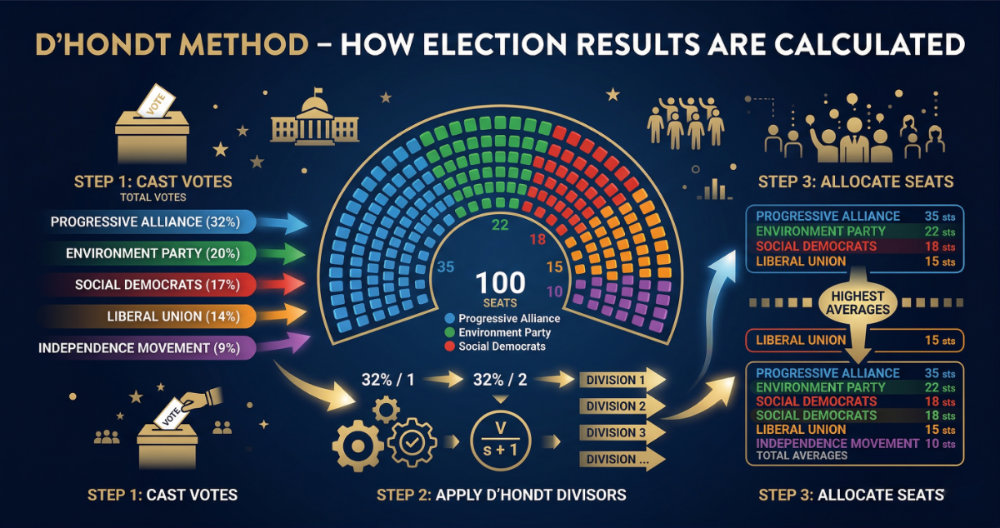
What Is the D’Hondt Method?
The D’Hondt method is a proportional representation system used to allocate seats in a parliament based on the number of votes each party receives.
It is named after the Belgian mathematician Victor D’Hondt.
The main goal of the system is:
👉 To distribute seats proportionally according to vote share
However, unlike perfectly proportional systems, it slightly favors larger parties. This often helps produce more stable governments.
How Does the D’Hondt Method Work?
Although it involves some calculations, the logic is straightforward.
Step-by-step process:
Allocate seats starting from the highest values
Count the total votes each party receives
Divide each party’s vote total by 1, 2, 3, 4, …
Rank all resulting numbers from highest to lowest
Example
Imagine an electoral district with 5 seats and the following vote distribution:
Party A: 100,000 votes
Party B: 60,000 votes
Party C: 30,000 votes
Now divide the votes:
| Division | Party A | Party B | Party C |
|---|---|---|---|
| ÷1 | 100,000 | 60,000 | 30,000 |
| ÷2 | 50,000 | 30,000 | 15,000 |
| ÷3 | 33,333 | 20,000 | 10,000 |
| ÷4 | 25,000 | 15,000 | 7,500 |
Next, select the top 5 values:
- 100,000 (A)
- 60,000 (B)
- 50,000 (A)
- 33,333 (A)
- 30,000 (B or C → typically awarded based on ranking order rules)
Final seat allocation:
- Party A: 3 seats
- Party B: 2 seats
- Party C: 0 seats
Advantages of the D’Hondt Method
✔️ Promotes stability
It slightly favors larger parties, making it easier to form strong governments.
✔️ Easy to implement
Despite being mathematical, the method is systematic and predictable.
✔️ Widely used
It is adopted in many countries, including Turkey and several European nations.
Disadvantages
❌ Smaller parties are disadvantaged
Even with a meaningful share of votes, smaller parties may end up with no seats.
❌ Not perfectly proportional
A party with 10% of the vote does not always receive exactly 10% of the seats.
Why Does It Matter?
The D’Hondt method is more than just a calculation—it shapes political reality.
It influences:
- Representation fairness
- Coalition dynamics
- Election strategies
Understanding this system is essential for anyone working with election simulations, political analytics, or data-driven decision-making.
Using the D’Hondt Method in Simulator
With Simulator’s D’Hondt simulation tool, you can quickly and easily perform D’Hondt calculations. Simply enter the party votes and get instant seat allocation results:
- Test different vote distributions
- Instantly calculate seat allocations
- Run multiple election scenarios
👉 This allows you to answer a critical question:
“How do changes in vote share affect the final outcome?”
Conclusion
The D’Hondt method is a cornerstone of modern electoral systems. While simple in structure, its impact on political outcomes is significant.
If you’re working on election modeling, analytics, or simulation platforms, understanding the D’Hondt system is not optional—it’s essential.